


What is Baccarat: Definition and History
Baccarat is a classic casino card game often likened to blackjack but more straightforward in rules and gameplay. One of the most concise yet relatively low-risk casino games, it’s considered a favorite among beginners and high rollers. Visit a physical or live casino and see that Baccarat has many exciting variations.
Definition of Baccarat
Collins defines Baccarat as a card game where two or more players gamble against a banker. Often referred to as Baccarat outside the United States, Baccarat’s name originates from the Italian word for “zero,” reflecting the game’s rule that face cards and tens are valued at zero. If you’ve played in a casino, you may have heard of its other variations, such as chemin de fer (chemmy) and punto banco. Baccarat's simple gameplay, excellent odds, and flexible gameplay make it an exciting experience.
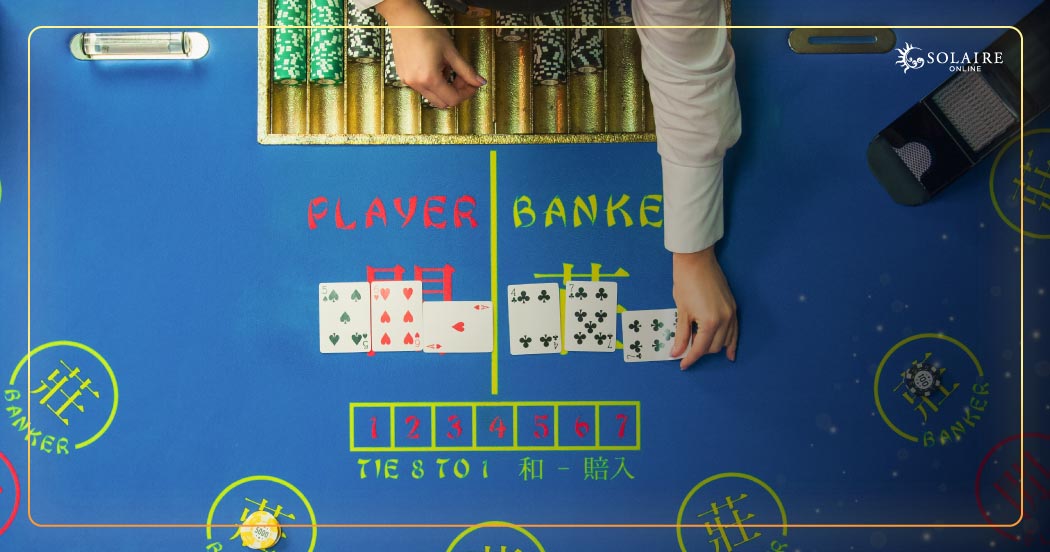
Baccarat Rules and Gameplay
The objective of baccarat is simple: to achieve a hand total of nine or as close as possible, using two or three cards from a deck. The classic game involves three to eight 52-card decks without jokers, shuffled together and dealt from a dealing box or shoe. Each card has a specific value. It consists of face cards where cards with the number 10 were counted as zero and the rest of the cards have the same numerical value. The last digit of the total sum determines the outcome. For example:
Player holds 2 cards: 7 and a 5
7+5 = 12
Hand total: 2 not 12
Players compete against the "banker," aiming for the highest total. Dealt hands face down, with a natural of 8 or 9 resulting in an immediate win, unless both the player and the banker have the same natural, resulting in a tie. Players stand for totals of six or seven. They draw a third card with a total of five or fewer. The banker’s actions are more complex, with specific rules on when to stand or draw based on the player’s hand.
Baccarat Strategy
Baccarat is known to have the lowest or lower house edge in comparison to other casino games. It is mainly relevant to betting on the banker. Experts recommend consistently betting on the banker due to its statistically highest success odds. Here’s the approximate house edge for each bet:
Banker bet—1.06%
Player bet - 1.24%
Tie Bet - 14.4%
Types of Baccarat
Today, Baccarat has evolved into several variations, each with its twist. Here are the most common ones:
Punto Banco
Is a popular and modern version of Baccarat. It shares the same rules as traditional blackjack. Players play this game with six to eight standard decks of 52 cards.
Chemin de Fer (chemmy)
A fast-paced form of Baccarat that uses six standard decks of cards. Players take turns being the banker.
Baccarat Banque
Similar to Chemmy, this version allows players to take turns playing the bank. However, the player who makes the highest wager becomes the banker for the entire shoe (the set of cards in play) or until they exhaust their bankroll.
Mini Baccarat
It's a simplified Baccarat game using eight decks with the same basic rules but fewer players and lower stakes.
EZ Baccarat
A modern variant that eliminates the 5% commission on winning banker bets, which is typical in traditional Baccarat.
Three-card Baccarat
Played with a 52-card deck, this is a simplified version of Punto Blanco and classic Baccarat. The hand with three face cards receives the highest payout, followed by a hand with nine. The hand with the highest number of face cards wins in a tie.

Origins of Baccarat
Baccarat’s origins are enigmatic, with a history intertwined with Italian and French gaming traditions. The Center for Gaming Research Occasional Paper Series points to 13th and 14th-century Italy as its likely birthplace. Some legends recounts that during the 15th century, an Italian man by the name of Falguiere created the modern form of Baccarat.
Later on, the Italian card game called Macao surfaced and was known as "Italian Baccarat." where the winner is determined by the hand with the hand value closest to nine. Macao has a longer documented history than Baccarat, though, and while it may have influenced its development, the connection remains speculative. Another potential ancestor is La Her, a game from the 17th century that shares many similarities with Baccarat.
Baccarat’s evolution continued in France, where it became closely associated with aristocracy. Several game variations emerged, leading to its formal recognition by the mid-19th century. The first recorded mention of the game appears in Album des Jeux, a collection of rules for card and gambling games published in 1847. This marked the beginning of Baccarat’s rise in popularity.
Baccarat was introduced to Nevada in 1958 when the Sands Hotel & Casino in Las Vegas opened a Chemin de Fer table. However, this version never gained much traction. In 1959, Tony Renzoni, an American casino operator, finally brought Baccarat to Las Vegas. After encountering Punto Banco in Cuban casinos, Renzoni saw the potential of this version and introduced it to the Sands. This marked a turning point for Baccarat, making it the glamorous high-stakes game we know today.
Experience Baccarat in Solaire Live Casino
In its early days, the European elite primarily played Baccarat. Over the years, it has gone beyond its aristocratic roots, finding its home in casinos worldwide. Still, Baccarat remains a game associated with refined sophistication. Its colorful history, exciting variations, and simplicity make it a favorite for casual players and experienced rollers.
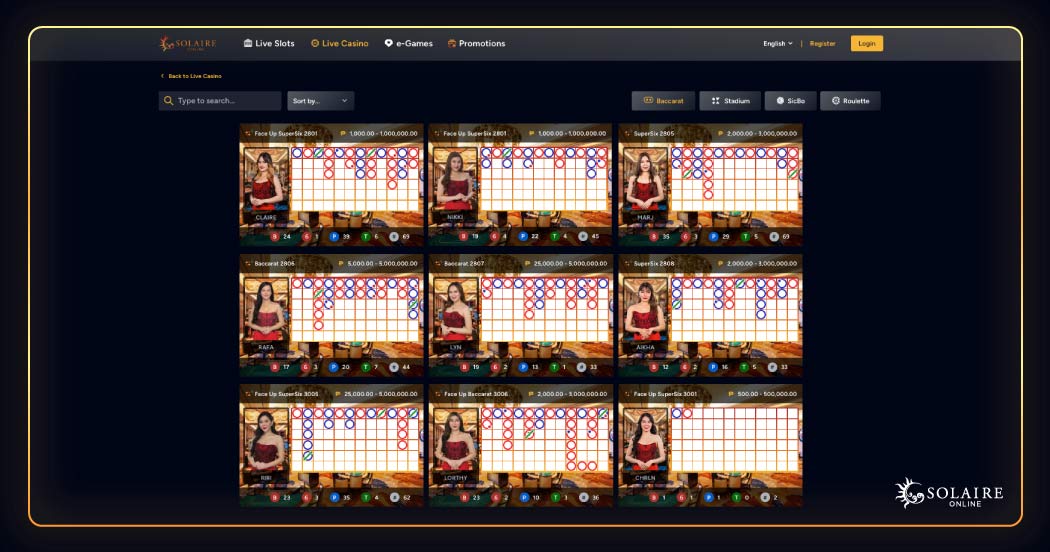
Are you prepared to immerse yourself in the excitement of this timeless game? Solaire Live Casino online offers the perfect setting to indulge in a game of Baccarat Online. We provide unique variants such as Panda Baccarat, Baccarat Mega Six, and Baccarat Rush, which you won’t find on other gaming tables. With live dealers, immersive gameplay, and secure online access, Solaire brings the glamour of the casino floor directly to you. Enjoy Baccarat anytime, anywhere, and test your luck in one of the most iconic card games ever created.